
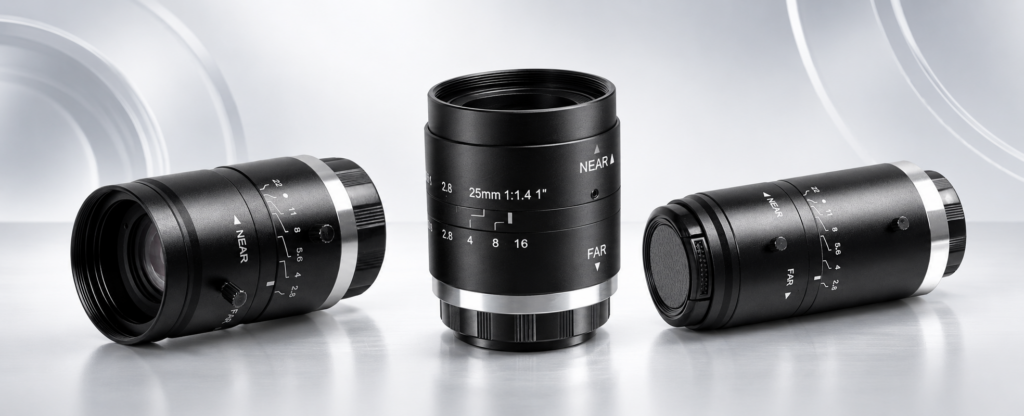
The “Eyes” of Industry 4.0: Why Quality Matters
In the era of Industry 4.0, automated production lines and smart manufacturing heavily rely on machine vision systems to perform complex tasks such as quality inspection, measurement, and robotic guidance. If the image sensor is the “brain” of the camera, the industrial lens acts as its “eyes.” A high-performance lens captures crisp, distortion-free images, directly determining the accuracy and reliability of the entire automated system. Investing in the right optical components is not just about upgrading equipment; it is about minimizing error rates and maximizing production efficiency.
When deploying machine vision in demanding environments like semiconductor manufacturing or automotive assembly, off-the-shelf commercial lenses simply do not cut it. Industrial lenses are engineered specifically for continuous operation, resisting vibrations and maintaining stable focus over millions of cycles. Understanding the technical nuances of these lenses is the first step toward optimizing your supply chain and technical infrastructure.
Key Technical Parameters to Consider
Selecting the optimal industrial lens requires matching the optical specifications to your specific inspection requirements. Buyers and engineers must evaluate several crucial parameters to ensure seamless integration.
The Importance of Build Quality in Factory Environments
Optical brilliance must be matched by mechanical ruggedness. Factory floors are challenging environments characterized by constant micro-vibrations, dust, temperature fluctuations, and continuous mechanical movement. Lenses constructed with plastic components are prone to thermal expansion and mechanical wear, eventually leading to focus drift and blurry imaging.
To combat these harsh conditions, professional-grade lenses utilize a full metal housing. This rugged construction not only protects the delicate internal glass elements but also ensures that the locking screws for focus and aperture remain tightly secured, preventing any accidental shifts during high-vibration machinery operations. When procuring lenses for global B2B projects, prioritizing full metal durability significantly reduces maintenance costs and system downtime for the end-user.
Choosing the Right B2B Partner for Optical Solutions
For OEMs, system integrators, and distributors, sourcing the right hardware is about more than just reading a spec sheet; it is about securing a reliable supply chain. Partnering directly with a reputable manufacturer ensures consistent batch-to-batch quality, competitive wholesale pricing, and the flexibility to accommodate custom requirements.
Brands like Gofocazi have established themselves as trusted sources in the precision optics industry. By offering specialized products engineered for machine vision—combining high-precision optics with robust, all-metal designs—they empower businesses to build automation systems that stand the test of time. A strong factory-direct partnership cuts out unnecessary middlemen, providing faster turnaround times from rapid prototyping to mass production deployment.
Whether you are upgrading an existing inspection line or developing a new robotic guidance system, prioritizing optical clarity and mechanical durability will yield long-term operational dividends. We invite engineering teams, procurement managers, and B2B distributors to explore our comprehensive catalog of machine vision lenses and reach out to our export team to discuss tailored solutions and bulk pricing for your next automation project.